Background
I’m an iOS Engineer, and like many engineer in the tech industry, recent layoff waves at tech giants like Amazon and Google have sparked not only job insecurity — they’ve fueled a deep anxiety about the future of our role itself. The relentless growth of generative AI is fundamentally reshaping the work of software development, leading us to a crucial, existential question: The challenge isn’t whether we’ll keep our jobs, but what a mobile engineer will actually be building five years from now.
I’ve channeled this anxiety into exploration. This article records my journey to understand the fundamental shift from traditional apps to Agentic AI, detailing the new architecture required and identifying the high-value skills developers must focus on to remain essential.
Key Takeaways (TL;DR)
The Challenge:
Mobile engineers face an existential shift — it’s not about job security, but what we’ll be building in 5 years as AI transforms from conversational tools to autonomous executors.
The Shift:
- From Apps → Agentic AI: Traditional UI-based apps evolving to Zero-UI experiences
- From Screens → APIs: Function Calling becomes the new primary interface
- From Pure AI → Neuro-Symbolic: Combining AI’s adaptability with code’s reliability
The Solution Architecture:
- Function Calling — Bridge between AI intent and executable code
- Data Storage — Persistent memory for context
- Durable Orchestration — Reliable multi-step execution
- FaaS — Serverless execution environment
The Path Forward:
Transform into T-shaped professionals with deep technical expertise (iOS/Android) plus broad skills (UX, backend, AI integration) to remain essential in the Agentic AI era.
The Shift: From Apps to Agentic AI
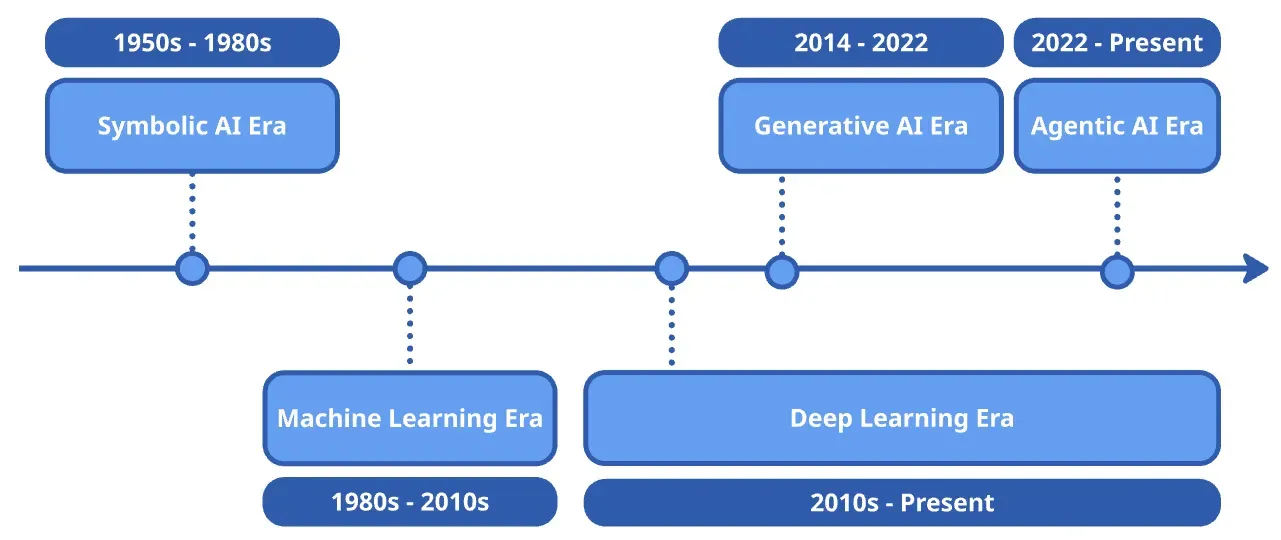
Figure 1: The evolution of AI
The Catalyst for the Agentic Era
While the Generative AI Era laid the foundational models, the launch of ChatGPT in late 2022, reaching 100 million users in two months, acted as the catalyst for the Agentic AI Era. This period marks AI’s significant shift from conversational tool to autonomous executor. In other words, AI systems can now act independently.
AI Agent v.s. Agentic AI
Agentic AI represents a major evolution in artificial intelligence. The key difference between Agentic AI and the older AI Agent paradigm lies in the complexity and level of self-management the system exhibits. Agentic AI moves beyond executing single-step commands; it truly functions as a personal assistant by acting based on a user’s intent (what they want) rather than explicit, step-by-step instructions.
Apple’s WWDC 24 keynote provided the perfect blueprint for understanding this transition. Consider the complex user query: “One of my meetings is rescheduled for late afternoon, and I’m wondering if it’s going to prevent me from getting to my daughter’s play performance on time.”
- Traditional AI Agent Paradigm: The user would have to manually provide the system all necessary information, such as: “The theater is here,” and “Check traffic after 5 PM.” The system would then deliver a single-step answer. It requires explicit commands and data input to function.
- Agentic AI Paradigm: The system autonomously reasons (plans and thinks for itself). It utilizes its persistent memory (drawn from past emails or calendar events) to already know the location of your daughter’s play and your workplace. When the meeting is rescheduled, the Agentic AI proactively and autonomously alerts you to the potential delay. It truly functions as a personal assistant by self-managing complex situations and taking proactive action.
The Implication for Mobile
This shift isn’t just theory. According to Gartner’s 2024 report, 33% of enterprise software applications will include Agentic AI by 2028, enabling 15% of day-to-day work decisions to be made autonomously.
This forces us to ask a critical, existential question: If AI is doing the thinking and the clicking, what role is left for the mobile application?
The answer lies in reimagining how users interact with technology altogether. Traditional app interfaces — with their buttons, menus, and navigation flows — were designed for human fingers and eyes. But when AI becomes the primary actor, these visual elements become unnecessary friction. This realization leads us to a radical new design philosophy: Zero UI.
Next, let’s dive into the technical architecture that powers this shift.
The New Interface: Zero UI and Action-Centric Design
The rise of the Autonomous Agent fundamentally changes the mobile front-end. The goal is a Zero-UI Experience, where interaction relies on voice, gestures, or context, rather than navigating screens and buttons. As OpenAI CEO Sam Altman suggested, the interface will “almost melt away,” allowing the user to simply state their intent and trust the machine to fulfill it. According to Global Information’s 2025 report: the VUI (Voice User Interface) sector is expected to grow to nearly $68 billion by 2029.
This experience is achieved because the value of the application is shifting from the User Interface (visual screens) to the Execution Interface (where the focus is on getting things done).
On the mobile side, the user will increasingly trigger complex tasks without ever opening the app — saying, “Siri, log my lunch and check my budget.” Therefore, the most critical design choice for a future-proof mobile application is to adopt an Action-Centric, API-First paradigm (an approach where the app’s functions are designed to be called by machines first).
This is where Function Calling becomes the new primary interface.
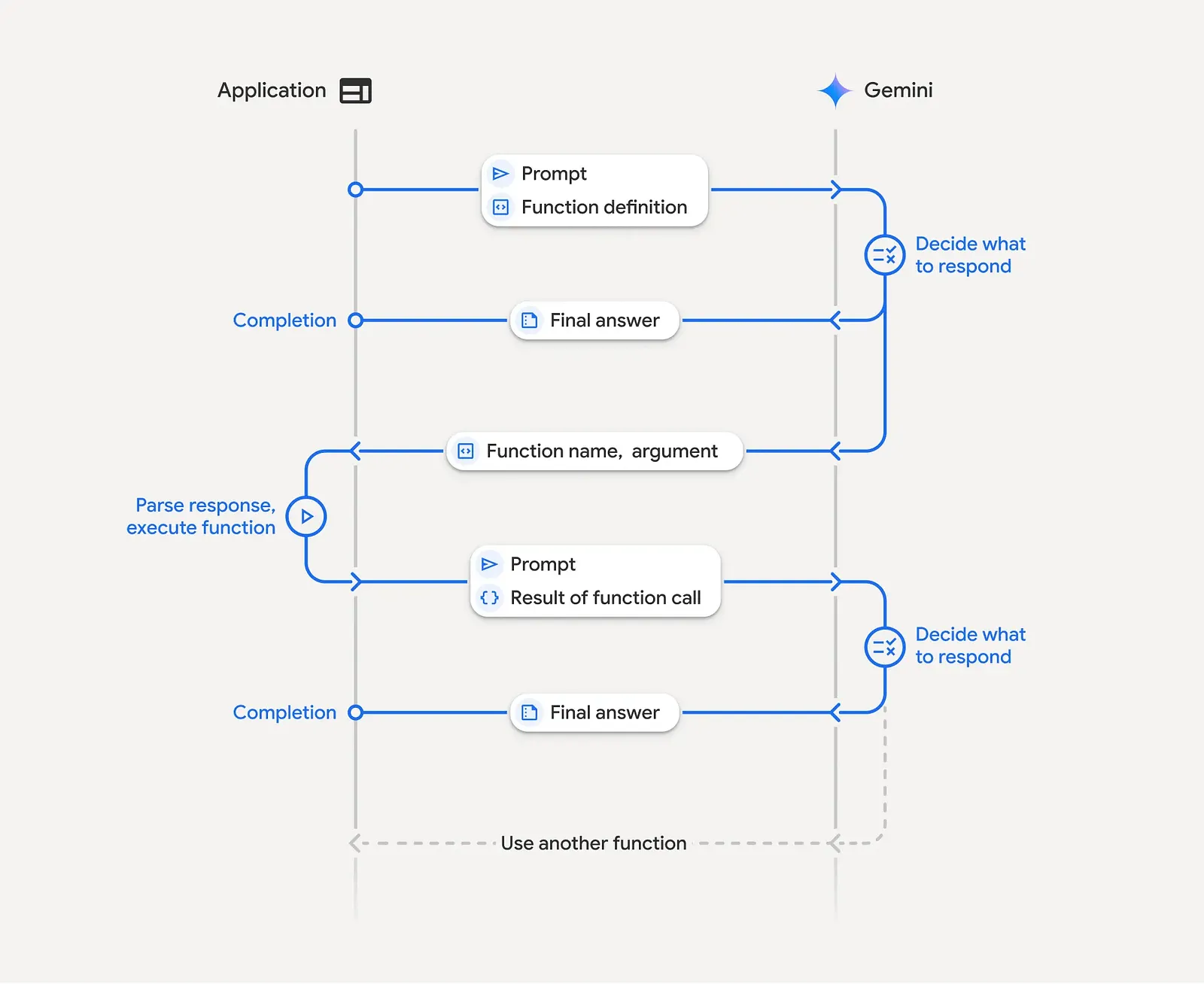
Figure 2: The Function Calling Flow. Source: Google Gemini API documentation, illustrating how the LLM translates natural language intent into a structured, executable function call.
As demonstrated by the Gemini process, the core mission of our code is no longer to render pixels (design visual screens), but to expose precise, well-defined capabilities (e.g., log_transaction(amount, category)) that the LLM Agent can understand and call. The future-proof mobile engineer must think of their app not as a series of screens, but rather as a collection of robust, ready-to-be-called APIs designed specifically for machine consumption.
The Foundation of Trust: Neuro-Symbolic Architectures
As we shift to an Action-Centric paradigm, the reliability of the underlying execution becomes the most critical responsibility for the engineer. This leads us directly to the concept of Hybrid Architectures, often termed Neuro-Symbolic architectures. In this model, the two core systems of AI work in tandem:
- Neural (LLMs): Excels at adaptability, semantic understanding, and complex, multi-step planning. It handles the ambiguous human language.
- Symbolic (Mobile Code / FaaS Code): Excels at reliability, precise computation, and enforcing explicit rules. This is our traditional, deterministic code.
Pure Neural systems are plagued by issues like hallucination and opacity (lack of transparency in decision-making). While Retrieval-Augmented Generation (RAG) can solve the knowledge gap, it cannot solve the logic reliability gap. For high-stakes applications — such as healthcare, core regulatory systems, and, crucially, financial services like our ledger application — security and auditability are paramount. The forward-thinking developer’s responsibility is to build the Symbolic Layer (the FaaS/Toolkit). We must provide the Agent with a trustworthy, deterministic execution engine that performs all safety-critical functions, such as balance calculations, transaction logging, and hard-coded fraud checks. The Agent (Neural) proposes the move, but our code (Symbolic) is the final, auditable executor.
The Four Pillars of Trustworthy Agent Execution
The Neuro-Symbolic split immediately clarifies the role of our core technical components. For the Agent to transition from simple conversation to a reliable, autonomous executor, it requires four critical architectural pillars to operate within this new trusted framework:
- Function Calling (The Bridge): Serves as the communication layer, translating the Neural Layer’s ambiguous intent into the Symbolic Layer’s structured, executable code (APIs).
- Data Storage (The Memory): Provides the Agent with the persistent context and history it needs for reasoning. This allows the Neural Layer to propose actions based on past states and user preferences.
- Durable Orchestration (The Process Manager): Ensures complex, multi-step actions (like checking traffic and booking a ride) execute reliably and can resume after failure.
- FaaS (The Execution Environment): This is the Serverless backend where the symbolic code (functions) is actually run. It offers the necessary scalability and security while dramatically reducing operational complexity and costs, as code only runs when the Agent needs it.
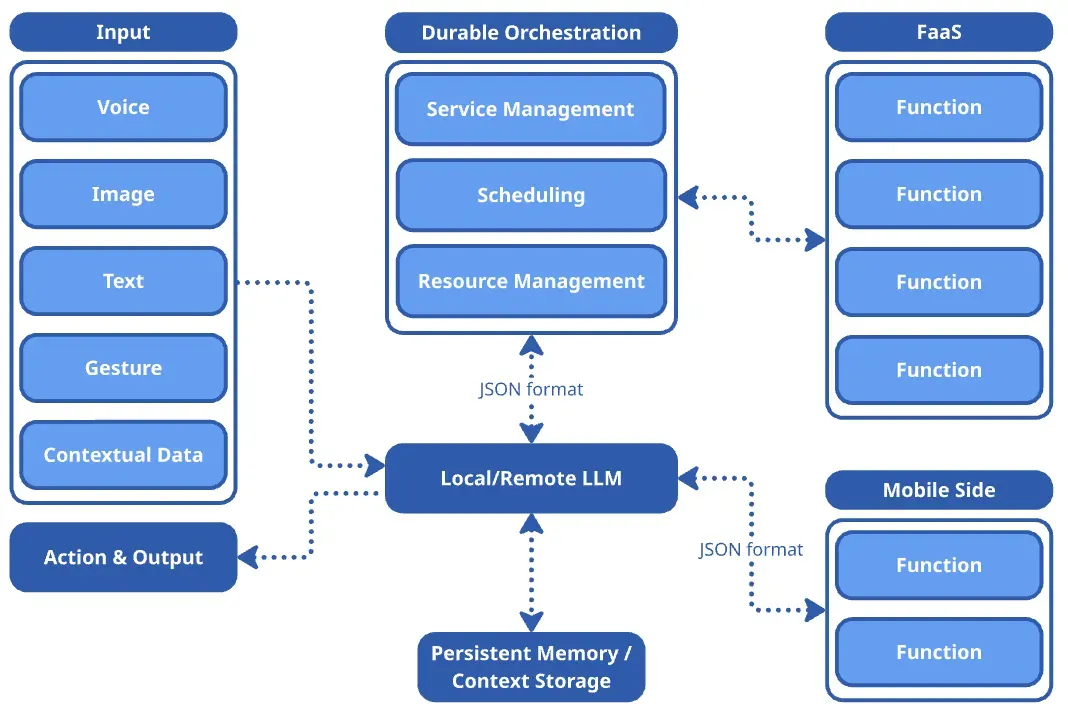
Figure 3: Neuro-Symbolic Agent Framework
This figure illustrates how the Local/Remote LLM receives multimodal Input and leverages the Mobile Side and Durable Orchestration to execute actions. The LLM translates intent into Function Calls (JSON format), which are routed to either Mobile Side Functions (for local execution) or the Durable Orchestration engine (for remote, reliable, multi-step execution). Both execution environments draw upon Persistent Memory and ultimately result in the final Action & Output.
Conclusion
In the face of relentless AI progress, I believe that personnel streamlining across companies is an expected and perhaps inevitable trend. For us to survive — whether starting a new venture or seeking a new role — we must aggressively expand our skill set, transforming into T-shaped professionals with deep technical expertise and broad interdisciplinary knowledge (UX, backend, etc.).
For my part, I will continue to deepen my skills in UX and backend engineering while persistently exploring the developmental trends within this Agentic AI era. Thank you!
References
- Agentic AI: A Comprehensive Survey of Architectures, Applications, and Future Directions
- WWDC 2024 — June 10 | Apple
- Function calling with the Gemini API
- Intelligent Agents in AI Really Can Work Alone. Here’s How.
- Global Voice User Interface Market 2025–2029
- Sam Altman: The Future of OpenAI, ChatGPT’s Origins, and Building AI Hardware